Stereoscopic Comic Immersion
Do stereoscopic comics provide a more immersive experience than standard 2D comics?
PROJECT 03
2 weeks
Team project
UX Research
Duration
Type
Role
Stereoscopic Comic Immersion
UX Research | Illustration
“Do stereoscopic comics provide a more immersive experience than standard 2D comics?”
To investigate the hypothesis, a structured survey will be conducted utilizing a detailed questionnaire. Participants will be required to view two sets of images and cartoons: one in 3D (stereoscopic) and the other in 2D (standard). Upon viewing, they will complete the questionnaire to provide their observations and insights on key aspects, including immersion, stereoscopy, and the impact of the comic format.

Scope and limitations
This subject offers the chance to play around with the idea of stereoscopy in comics. Stereoscopy has the potential to improve comic book immersion, although this potential has previously gone unrecognized.
The study has been restricted to just anaglyphs and their use in comics due to time constraints. The study's equipment is likewise restricted to Anaglyph 3D glasses, excluding the other stereoscopic gimmick images and polarized stereoscopy. The study will only focus on the anaglyph-based stereoscopic comics' immersive qualities.
Data Collection
Primary Data Collection
The use of stereoscopy in still images can take many different forms, including autostereograms, stereographs, anaglyphs and the new polarised 3D.
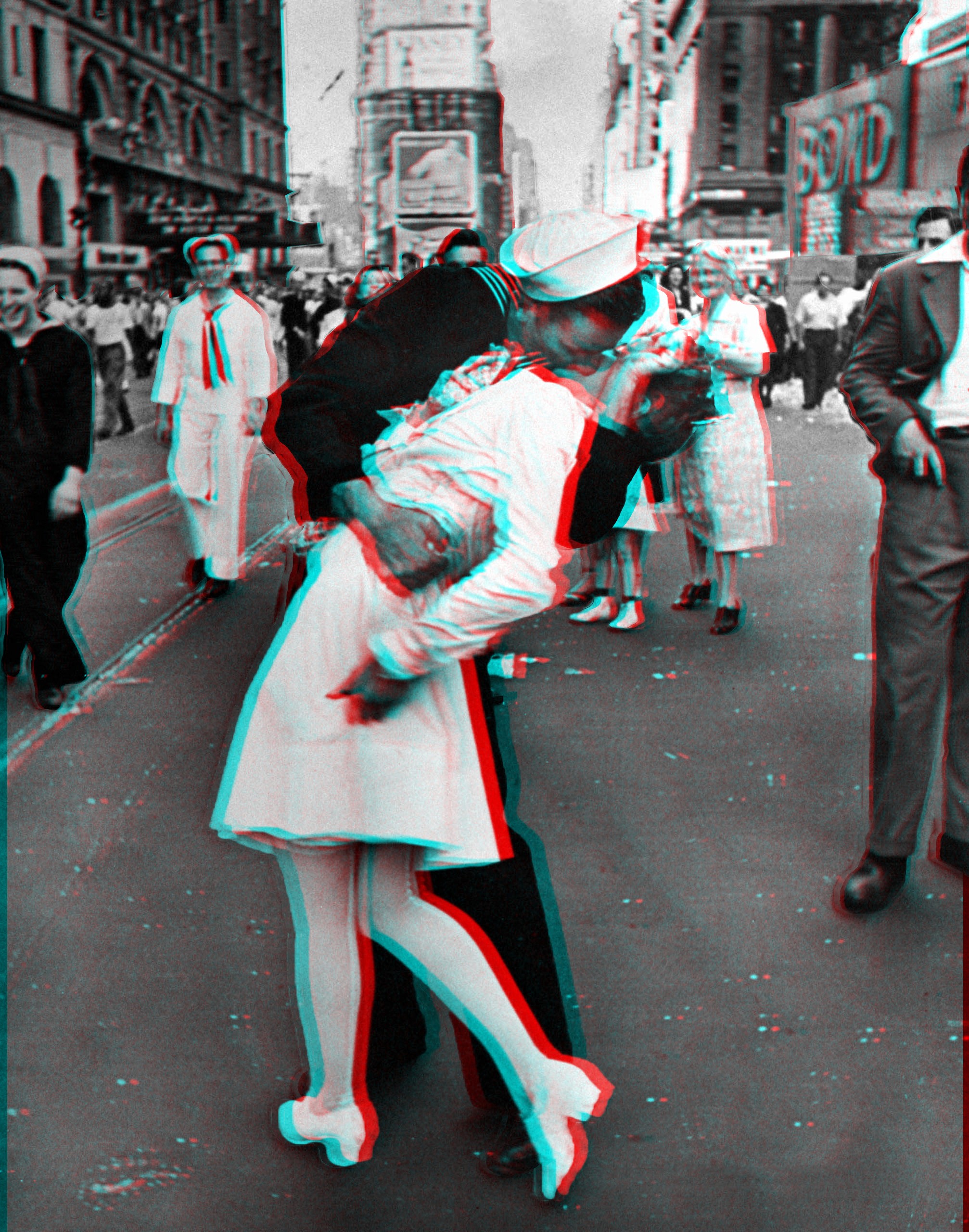
Following images were converted to anaglyph images digitally.


Evil Girl meme : The meme image: An evil girl grinning with a house on fire in the background. A source for internet humor.
The Kiss by Alfred Eisenstaedt : V-J Day in Times Square (also VDay and The Kiss) is a photograph by Alfred Eisenstaedt that portrays a U.S. Navy sailor grabbing and kissing a stranger—a woman in a white dress—in New York City's Times Square on August 14, 1945.
Secondary Data Collection
Anaglyph 3D glasses were selected for this investigation. Various techniques were employed to produce the anaglyphs.
The photographic method involved capturing two photographs with an intraocular distance of 2.5 inches.
In the first image, the color red was eliminated, and in the second, the color blue was removed. The anaglyph was created by superimposing these images. This method was applied to both close-up and distant images. The displacement map technique edited existing images and hand-drawn illustrations using displacement maps to create the anaglyph effect.
Hand drawn graphics : Drawn images were also similarly treated to create Anaglyphs using the same displacement method.
Single Photograph edited digitally : A single image was edited using displacement map, which alters the image to make and anaglyph.


User Testing
Questionnaire Design

The questionnaire was created to examine the degree of stereoscopy immersion using a variety of picture types, including photographic images, hand-drawn graphics, coloured images, black-and-white images, etc. Additionally, a two-page stereoscopic comic was created to explore the degree of immersion.
Selection of users, images and equipment
For the study 12 volunteers with ages ranging
from 19 to 31 were recruited at random. The participant’s eyesight varied, and several of them used corrective lenses.
Anaglyphs in both black and white and colour were created from the selected photographs. Images from the internet that the user had previously seen were also selected for their recall value and potential effects on stereoscopy involvement and immersion.
During the testing, the user wore a set of 3D Anaglyph glasses with Red and Cyan lenses, and the images were shown on a laptop screen. Since it was expected the user was fairly comfortable with the notion of 3D glasses due to exposure to 3D entertainment in popular culture, the transition of pictures from photographs to drawings was done on purpose to make the transition easier.
Anaglyph 3D glasses A participant in the study testing the comic with 3D glasses

A participant in the study testing the comic with 3D glasses
Comparative analysis
While only 3 of the 12 respondents claimed to have read a 3D comic previously, 8 of the 12 participants stated they would pick one up, valuing the experience over the plot.
When shown the image of the "Kiss," 8 out of 12 participants chose to take a keener interest and considered the image interesting in stereoscopic form.
The reader's interpretation of the two-page comic was left up to them. Later, the user was given clarification on a number of issues, and some of those were documented in the accompanying chart based on observation.
Tecnique
Number of People
2 Photos superimposed


Inferences
Following are some conclusions drawn from the data gathered during the user testing of the comics and anaglyph images:
Colored anaglyph has better immersion than monochrome image.
When two images are combined to form an anaglyph using a certain intraocular distance, the coloured anaglyph provides a more immersive experience than the monochrome one.

Monochrome for single source picture conversion.
Anaglyphs that are produced from a single picture source perform better in monochrome than in colour.
Short narrative aids immersion 3D comics.
Comics with fewer pages or shorter runs perform better since the reader's immersion is primarily caused by the novelty of stereoscopy but is adversely affected by the discomfort of wearing 3D glasses.
The genre of stories that will be told through 3D comics must be carefully chosen because the immersion lasts longer with compelling material and a revisit value.


Side effects with longer engagement.
As seen in previous research, wearing 3D glasses can cause a variety of uncomfortable side effects, including dizziness and hazy vision when worn for an extended amount of time. This has an impact on the reader's ability to fully engage with the comic.


THANK YOU